

Short answer
Choose a provider you can pay in Naira, pick WhatsApp and a country, rent a SIM-based (not VoIP) number and type in the six-digit code WhatsApp sends to it. On 30 October 2026, YoungPG Virtual listed WhatsApp numbers from ₦417 for Italy, ₦2,117 for the UK and ₦4,160 for the US. Turn on two-step verification the moment you’re in: the number is yours for minutes, and the account has to outlive it. For a line you’ll keep for years, a second SIM registered to your NIN is the better tool.
What a virtual number is, and why people use one
A virtual number is a phone number you rent online. When an app sends a verification code to it, the text lands in a dashboard on the provider’s website instead of a SIM in your phone. You copy the code, paste it into the app, and you’re through.
People in Nigeria use them for ordinary reasons:
- Privacy. Signing up for an app or a promotion without handing over your main line, which then fills up with spam.
- A separate line. Keeping a side-hustle account apart from personal chats without carrying a second phone. If you’ll keep that account for years, read the warnings below first.
- Foreign sign-ups. Some apps and websites want a number from their own country before they let you in.
- Testing. Developers use them to test sign-up and OTP screens in the apps they build.
WhatsApp has one catch. Your phone number is your login, so whoever controls that number later can ask WhatsApp for a fresh code. A rented number is fine for getting in, and risky as the only key to an account you care about. Most of this guide is about handling that risk.
One-time numbers and rented numbers
Providers sell numbers in a few ways. What separates them is how long the number stays yours.
| Type | How long it’s yours | Good for | The catch |
|---|---|---|---|
| One-time (activation) number | Minutes, for one code | Verifying an account once | No second code later |
| Short rental | Hours or days | Apps that send several codes while you set up | Gone when the rental ends |
| Long-term rental | Weeks or months, while you pay | A second line you check often | Stop paying and the number can go to someone else |
| Your own SIM or eSIM | As long as you keep the line active | Your main WhatsApp, a business line, your bank | Must be registered to your NIN |
If you’re verifying something you’ll keep for years, such as your main WhatsApp or a business line customers will save, a rented number is the wrong tool. Get a SIM in your own name. The NCC’s rules for registering subscribers make the NIN the only accepted ID for a new line, and allow up to four SIMs on one NIN on each network.
VoIP or non-VoIP: why WhatsApp turns some numbers down
A VoIP number runs over the internet only, like the numbers some calling apps and free “online number” sites hand out. A non-VoIP number sits on a mobile network’s range, the same as the SIM in your phone.
WhatsApp’s help centre lists VoIP numbers among the numbers it doesn’t support, along with toll-free and premium-rate numbers, and landlines except on the WhatsApp Business app. Its terms of service also ask you to register with your current mobile phone number. So for WhatsApp, rent a SIM-based number. Other apps and banks may run similar checks.
A SIM-based number can still fail. If someone used it on WhatsApp before, or WhatsApp sees too many attempts, you may get no code or a “Login not available right now” message. WhatsApp’s advice for that message is to wait and then try once, because trying again too early can start a new waiting period.
Free Nigerian numbers for verification: why they’re a trap
Search for a free Nigerian number for SMS or OTP and you’ll find websites that list numbers and show every message they receive on a public page. That’s the problem. Anyone watching the page sees your code, and anyone can use the same number to request a new code for your account tomorrow.
Nigerian numbers carry a second problem. Nigerian SIMs must be registered with their owner’s NIN, and the NCC warns people never to let anyone register a SIM with their NIN, because crimes committed on that line trace back to the NIN owner. An account built on a stranger’s line rests on a stranger’s identity.
There’s no safe free option. For a code you need once, a private paid number can cost less than ₦1,000 (see the prices below). For a Nigerian number you’ll keep, buy a SIM and register it to your own NIN.
How to get a virtual number for WhatsApp, step by step
- Decide whether you’ll keep the account. If it’s your main WhatsApp or a business line, use a SIM in your name and skip the rest of this list.
- Choose a provider and fund a small amount. Use the checklist further down. Top up in Naira for one or two numbers, not a month’s worth.
- Pick WhatsApp and a country. Choose the exact app you’re verifying, because providers stock and price numbers per app. Check the price on screen before you rent.
- Rent the number and copy it with its country code. A timer starts, so keep WhatsApp open and ready.
- Enter the number in WhatsApp and ask for the code. WhatsApp sends a six-digit registration code by SMS or call. Watch for it in the provider’s dashboard, not on your phone.
- Type the code into WhatsApp. If no code arrives before the timer runs out, cancel the rental. A good provider puts the money back in your wallet automatically.
- Lock the account straight away. Open Settings, then Account, then Two-step verification, and turn it on. In August 2026 WhatsApp said it had upgraded this from a six-digit PIN to a full password. Add your email address, and add a passkey under Settings, then Account, then Passkeys.
- Move the account if it turns out you’ll keep it. Use WhatsApp’s Change number feature to move it to a SIM in your name while you still have access.
Do this before anything else. The minute WhatsApp opens on a rented number, turn on two-step verification and add your email. Chats, profile photo and contacts can wait.
What a virtual number costs in Naira
You pay per number, not per month. The price depends on the country and on the app you’re verifying, and it moves as stock comes and goes.
Here’s what YoungPG Virtual’s pricing page showed for WhatsApp on 30 October 2026. These are “from” prices; the price on screen when you rent is the one you pay.
| Country | WhatsApp number, from |
|---|---|
| Italy | ₦417 |
| Estonia | ₦947 |
| Germany | ₦973 |
| United Kingdom | ₦2,117 |
| Canada | ₦2,732 |
| United States | ₦4,160 |
| Hungary | ₦10,947 |
The lowest price anywhere on the site that day was ₦82.50 a number. Stock and prices there refresh every 30 minutes, so check before you buy. Your wallet is charged when a number is assigned and refunded automatically if no code arrives.
Compare that with a SIM. A line from a network stays yours as long as you keep it active and needs only your NIN, which makes it the right choice for anything you’ll keep.
What to look for in a provider
Plenty of sites sell numbers. Before you fund a wallet, check these:
- Naira funding through a licensed payment company. Card or bank transfer through a company on the CBN’s list of licensed payment service providers, not a transfer to a stranger’s personal account.
- Refunds when no code arrives. Read the refund policy. It should refund automatically when a number expires without a code. Expect no refund once a code has arrived, even if the app bans the number later.
- A clear reuse policy. Ask how long before a number goes to another customer. Shared or quickly recycled numbers are how strangers end up with your codes.
- The full price before you pay. The price on screen should be final, with nothing added at top-up.
- What happens to leftover money. Many providers only let you spend a balance on numbers. If withdrawal isn’t offered, top up only what you’ll use.
- A business you can reach. A support channel that answers, and terms that ban fraud. A site that welcomes any use, no questions asked, is one to avoid.
Where to get one: YoungPG Virtual
One option is YoungPG Virtual. It’s our own product: we built it and we run it, so read this recommendation knowing that. Here’s how it worked when we checked its pages on 30 October 2026:
- You fund one wallet in Naira by card or bank transfer through Kora, which is on the CBN’s list, or with crypto.
- Numbers come from more than 200 countries and are listed as SIM-based, not VoIP.
- Each number is held for about 20 minutes for one app. If no code arrives, the rental is refunded to your wallet automatically, as its refund policy sets out.
- A number isn’t given to another customer for at least 30 days after your rental.
- The wallet is for rentals. Under its terms, withdrawals to a bank are at the company’s discretion and need identity checks.
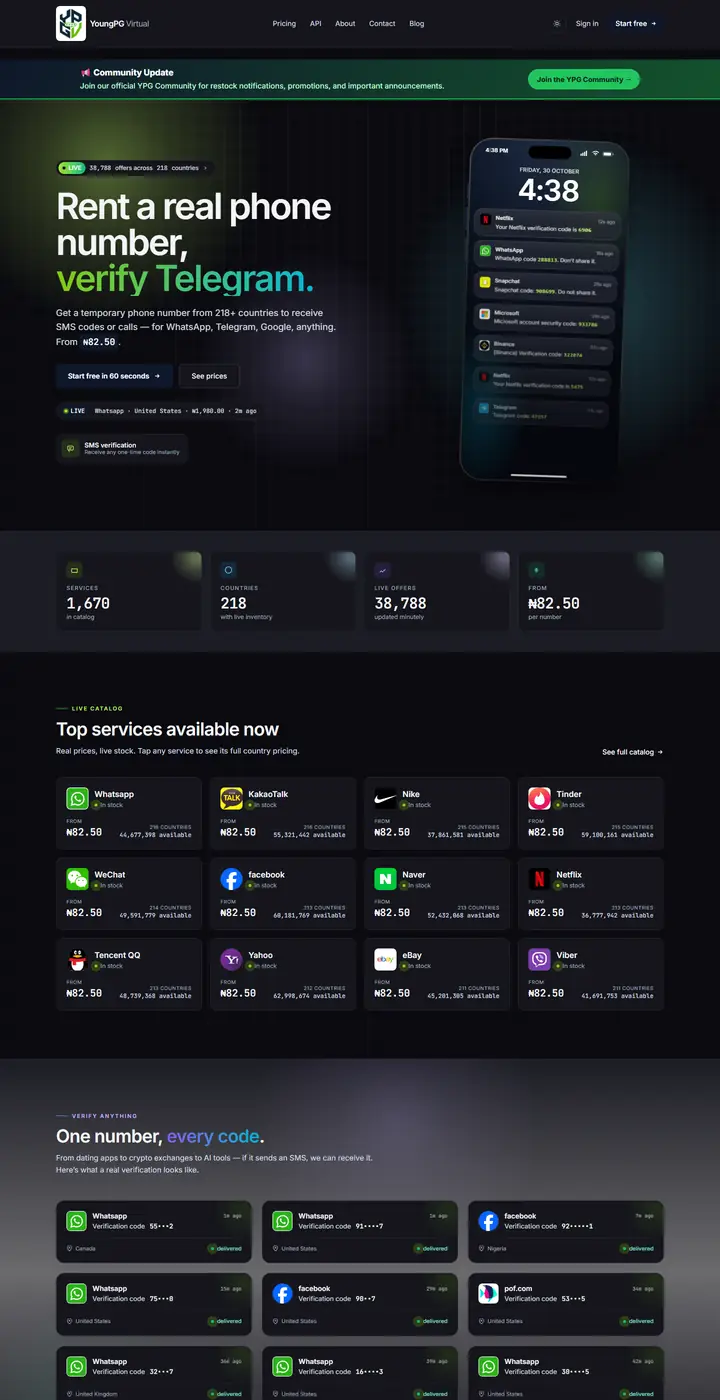

Hold it to the same checklist as any other provider. If it doesn’t suit you, the steps above work on any service that passes the checklist.
Mistakes that cost people their WhatsApp
Using a one-time number for an account you’ll keep
The number is yours for minutes. WhatsApp says that if you lose access to your number without using its Change number feature, you can permanently lose the account, and a chat backup can only be restored with the number it was made on. Change phones a year later and you may be locked out.
Leaving two-step verification off
WhatsApp says two-step verification helps stop someone taking over your account even if they get your one-time code. On a number that someone else may rent next month, it’s the difference between a scare and a stolen account. Add an email so you can reset the password if you forget it.
Sharing a code with anyone
WhatsApp treats the six-digit registration code as the only way to activate an account on a number. Nobody honest needs it from you: not a friend who “sent it by mistake”, not “WhatsApp support”. The same goes for your two-step password.
Using free public numbers
Everyone can read a code sent to a public page, and anyone can request the next one. Pay for a private number or use your own SIM.
Trying number after number in a hurry
Rapid attempts can trigger WhatsApp’s “Login not available right now” hold. If two numbers fail, change country or wait, rather than renting a third and a fourth.
Topping up more than you need
Wallet balances are hard to get back. Fund for the numbers you need today.
Use it responsibly: the law and WhatsApp’s rules
Virtual numbers are legal tools for privacy and verification. What you do with them is what the law looks at.
- The Cybercrimes Act. Section 22 of the Cybercrimes (Prohibition, Prevention, etc.) Act 2015 makes it an offence to fraudulently impersonate another person to gain an advantage, obtain property or put someone at a disadvantage, or to fraudulently use someone else’s password or other unique identification feature. The penalty is five years in prison, a fine of up to ₦7M, or both. The 2024 amendment left this part unchanged, and the NCC publishes the Act with that amendment on its cybersecurity resources page.
- WhatsApp’s terms. No impersonating anyone, no illegal or deceptive use, and no creating accounts through unauthorised or automated means. WhatsApp can suspend or end access for anyone who breaks them.
- Your NIN and other people’s. Don’t let anyone register a SIM with your NIN, and don’t use lines registered to someone else.
- Provider rules. YoungPG Virtual’s terms ban fraud, identity theft, spam and use that breaks the rules of the app you verify, and it shares allocation records with law enforcement when properly compelled. Expect the same from any provider worth using.
If a plan only works by pretending to be someone else, it’s fraud, whatever number you use.
Want to run your own virtual-number service?
Some readers want to sell numbers, not buy them. The business works like other reseller platforms: you buy numbers through upstream APIs, sell them in Naira from a customer wallet, and refund automatically when no code arrives.
The hard parts are the ones customers never see: refund logic that matches each upstream provider’s, a reuse policy, fraud checks on wallet funding, and records you can produce when law enforcement asks properly. Holding customer money in wallets also brings in the CBN and data-protection rules we cover in our guide to starting a VTU business in Nigeria.
We build virtual-number, VTU and wallet platforms, with a web dashboard and, if you want one, a customer app for Android and iOS. A fintech platform with us starts from ₦4M (see our prices). Send us your plan through the contact page or on WhatsApp.
Frequently asked questions
Is it legal to use a virtual number in Nigeria?
Yes, for lawful uses such as privacy and verifying your own accounts. Using any number to impersonate someone or to commit fraud is an offence under the Cybercrimes Act. WhatsApp’s terms also ban impersonation and accounts created by automated means.
Can I get a free Nigerian number for verification?
Not a safe one. Free sites show codes on public pages, and Nigerian SIMs must be registered with their owner’s NIN. If you need a Nigerian number you’ll keep, register a SIM in your own name; NCC rules allow up to four on one NIN on each network.
Why didn’t my WhatsApp code arrive?
Common causes are a VoIP number, a number that was used on WhatsApp before, or a country that’s short of stock at that moment. Cancel before the timer ends so your wallet is refunded, then try another number or country. If WhatsApp shows “Login not available right now”, wait and try once.
Can I keep a virtual number for WhatsApp?
Not a one-time number: it’s yours for minutes. Some providers rent numbers for weeks or months, but for an account you’ll keep, a SIM in your name is safer. Whatever you use, turn on two-step verification and add your email.
Can I withdraw money left in my wallet?
Often not. Many providers only let you spend a balance on numbers; on YoungPG Virtual, withdrawals to a bank are at the company’s discretion and need identity checks. Top up only what you need.
General information, not legal advice. Rules change; check the current version with the NCC, and WhatsApp’s own help centre, before you act.